
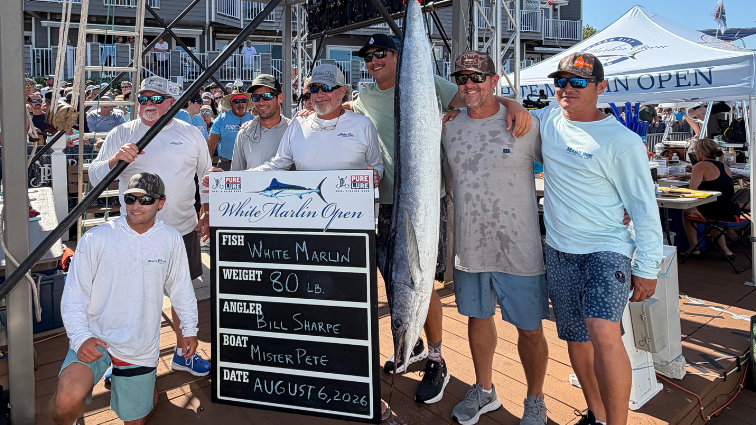
Article overview: Follow Mister Pete’s run at the White Marlin Open, from Charleston roots to a standout tournament performance. A story of persistence, strategy, and a shot at the leaderboard.
Every August, the White Marlin Open transforms Ocean City, MD into the center of the sportfishing world as hopeful crews chase life-changing payouts and a spot in offshore history. This year, the spotlight landed on 60’ Spencer MISTER PETE. The team has a longstanding relationship with HMY Yacht Sales, built through years of business and participation in the HMY Lowcountry Cup. That familiarity made their performance on one of the sport’s biggest stages all the more meaningful to witness. Their WMO win is a reminder of the level of dedication and consistency it takes to compete and win at the highest level.
It was MISTER PETE’S fourth time fishing the WMO and until this year, they never had great success. A few years ago, the team boated a white marlin but did not place. Coming from Charleston, where white marlin are not common, there's a bit of a learning curve. Ocean City brings a completely different set of conditions and a species not often fished, making it a challenge to dial in strategy.
As an out-of-town team, success required more than simply following the Ocean City fleet. Captain Alan Neiford of MISTER PETE relied on his network of trusted captains, years of experience, and understanding of the unique ocean patterns off of Ocean City. When HMY sat down with Alan, he explained how the convergence of the Gulf Stream, which pushes north along the coast, and the Labrador Current, which carries nutrient-rich water south, creates an ideal environment for these fish to gather.
For Alan, finding the fish came down to gathering information, trusting his instincts, and developing his own theory about where they would be. “I thank my owners for all their support, my guys in the pit who did amazing and a special thanks to all the Captains in my network that give manageable reports. It’s a big ocean and that information is invaluable in the decision making."
On the final day of fishing, that strategy led the team north and into unfamiliar water. They decided to break from the fleet, running five miles offshore beyond the last boat—and Alan had a good feeling about it.
Not even an hour into the tournament that day, they spotted two marlin and had marked another fish they had been circling. Just as Alan was about to make a turn, an aggressive bite came, hit the flat line, and took off. Their best guess was a tuna or small blue marlin. So, they started backing down on it. For the first few minutes of their fight, not much was happening when finally, the fish circled and jumped not even five feet from the cockpit. They had a white marlin. The crew exploded with energy, and the day completely shifted.
Alan described the moment the white marlin first surfaced: “It was so lit up in color, it looked like it had been plugged into the wall.” From there, the team stayed patient and deliberate, carefully working the fish through the rod tip.
The marlin eventually disappeared beneath the surface and headed deep, turning the fight into a true test of endurance. About halfway through the hour-long battle, it resurfaced, bringing the team within gaffing range for roughly 200 to 300 yards. But as they backed down on the fish, the churn of white water made visibility difficult, and their first attempts to gaff it came up short.
The pressure was intense. The team had to keep the fish on the rod while simultaneously backing down and trying to get a clean gaff shot. After seeing the marlin and knowing it was large enough to qualify for a weigh-in, there was no room for error. They had to keep the fish on.
Luckily, the fish made one critical mistake: it turned and came back underneath the boat. When it resurfaced, the crew finally had an opportunity to get into position and bring it aboard.
“That fish was not done fighting when we got it into the boat. It still had plenty left in him, but he made a mistake, and it worked out in our favor. He truly was a stubborn fish,” Alan recalls.
But even with the fish in the boat, the uncertainty wasn’t over. The crew realized they didn’t have a flexible cloth measuring tape—only a rigid metal ruler. Thinking quickly, they measured out 70 inches of monofilament and used it to gauge the fish from nose to tail. When they lined it up, the mono didn’t even reach the tail. This fish was clearly well over 70 inches.
Excitement quickly turned to disbelief. The crew knew they had something special, but the real confirmation wouldn’t come until they reached the scales.
Alan called in the catch over the radio, his voice breaking as the magnitude of the moment began to sink in. A friend, Thomas Garmany, was fishing aboard the Viking Demo and offered another piece of advice: measure the fish’s girth with mono and compare it against the measuring tape. If it measured 28 inches or more, Thomas told Alan, they could very well have an 80-pound fish.
The girth came in at exactly 28 inches. Now it was really starting to sink in.
The crew secured the fish and began breaking down the gear, raising the outriggers and clearing the baits. Then came the realization: the scales didn’t open until 4 p.m. It was only 9:45 in the morning. They had hours to kill.
So, rather than sit around and wait, the team reset and went back to fishing. The baits went back in the water, the outriggers went back up, and the crew got back to work while their catch waited for its moment at the scales.
Sometimes, good things really do come to those who wait.
The moment the number “80” appeared on the scale was one the crew will never forget. When we asked Alan and part-owner Rusty McClam what it felt like to see the weight confirmed, Rusty didn’t hesitate. “I almost took the boys overboard and into the water we were so excited,” he said.
Alan, however, was still taking it all in. He had remained cautiously optimistic throughout the day, refusing to assume they had something extraordinary until the number was official.
“We truly did not think that number was going to pop up on the screen. We did not know what we had, but we knew we had something,” Alan said. For the Charleston-based crew, bringing a fish aboard was already outside the norm. “In Charleston, it is not common to put the fish on the boat. We usually release them, and on top of that, we do not get to see white marlin all that often, so we truly did not know what we were working with.”
Rusty summed up the moment perfectly: “Lucky but prepared.”
For him, the significance of the day went far beyond the tournament. It happened to fall on his 43rd wedding anniversary and his daughter’s birthday—giving him three reasons to celebrate.
“The day had three great things: my marriage, my daughter being born, and then the tournament,” Rusty said. As they say, all good things come in threes.
As word spread, the support came pouring in. Friends, family, Charleston businesses, fellow fishermen, and offshore crews from across the region flooded MISTER PETE with calls, texts, congratulations, and messages of support.
For Alan, that response was almost as meaningful as the result itself.
“It is truly incredible. The two words I can come up with are love and support,” he said. “Knowing people have your back, feeling like the underdog, being from out of town—we are not these big-name guys. It feels good to fish with people of that caliber and be right up there with them.”
He never expected MISTER PETE to be the team everyone would be talking about.
“We are not going into it thinking we are going to win this thing. You do not feel that way in this kind of tournament. You do not go in believing it is going to be you.”
Rusty described the outpouring of support as simply “unreal.” It came from everywhere—from close friends and family to complete strangers who had witnessed the moment at the tournament.
There were hundreds of texts. People congratulated Rusty at his doctor's office. At the tournament, boats lined up as they left the scales, with crews on center consoles and pontoons cheering and shouting congratulations. Hotel guests stood on balconies ringing cowbells. And in a moment that felt almost scripted, the drawbridge even sounded its horn and opened early for them.
It was a celebration that extended far beyond the MISTER PETE crew.
And perhaps that is what makes tournament fishing so captivating. The sport is full of uncertainty. You never know whose day it will be, where the fish will show up, or how quickly everything can change. The anticipation, the strategy, the heartbreak, and the triumph are all part of what keeps fishermen coming back.
For MISTER PETE, this was simply their day. Alan put it best: “When it is your day, it is your day, and it was our day.”
The 60 Spencer is now headed to the Virginia Beach Billfish Tournament, running from August 19 through 22, 2026, out of Southside Marina at Rudee Inlet. The team is excited and ready to keep going.
We can't wait to see what the future holds for this team. Alan has been fishing his entire life and has been captaining for over 15 years. Out of his many accomplishments, it is safe to say the WMO win is his career’s biggest so far.
Rusty described it as “the biggest thing to ever happen for us. That money is helping change those boys’ lives. So proud of them; they deserve and earned it. Gordon, our mate, was on his last fishing trip before heading to New York for maritime school. I called his dad and told him they would be flying there in first class.”
The owners and crew of MISTER PETE would like to thank everyone for the support, the people of Charleston, and everyone involved in the South Carolina Governor’s Cup. MISTER PETE’S consistency has allowed them to compete at a high level, proving it is not just luck that puts you exactly where you need to be, and Alan’s decision making on the final day fishing in the WMO has proven just that.
A special thanks as well to HMY Yacht Sales professionals Harrison Hughes and Tim Gedick for their role in the program.